
 The Williston Northampton School is pleased to announce that Alan Alda, grandfather to a member of the Class of 2011, will give the Commencement address to the school’s 121 graduating seniors and the Williston community on Saturday, June 4, at 9:30 a.m. The ceremony will take place on the Williston quadrangle in front of the Reed Campus Center, weather permitting. This celebration will mark the 170th Commencement in Williston’s history. For those unable to attend the ceremony, it will be broadcast via live webcast. A baccalaureate ceremony will take place in the Phillips Stevens Chapel the previous night at 8:00 p.m.
Alan Alda has earned international recognition as an actor, writer, and director. He played Hawkeye Pierce on the classic television series M*A*S*H, and wrote and directed many of the episodes. His 33 Emmy nominations include performances for 30 Rock, The West Wing, ER, and Kill Me If You Can. He was inducted into the Television Hall of Fame in 1994. He hosted the award-winning series Scientific American Frontiers and was presented with the National Science Board’s Public Service Award for his efforts to broaden the public’s understanding of science.
For his role in The Aviator, Alda was nominated for an Academy Award; his other films include Crimes and Misdemeanors, Everyone Says I Love You, and Manhattan Murder Mystery. He also wrote and directed The Four Seasons, Sweet Liberty, A New Life, and Betsy’s Wedding. On Broadway, Alda acted in many plays and received Tony Award nominations for his roles in Glengarry Glen Ross, Jake’s Women, and The Apple Tree. His first memoir, Never Have Your Dog Stuffed, and Other Things I’ve Learned, became a New York Times bestseller, as did his second, Things I Overheard While Talking to Myself.


 The book’s inception goes back to Williston’s Intersession program in the 1980s. One of the courses Mr. Lipp offered was a course in math games. He invented several of the games, but many of them are well-known, including Tic-Tac-Toe and Connect-the-Dots. All of the games have an underlying math theme, even if it is not apparent at first. His previous two books, published in 2000 and 2001, were supplements to textbooks for AP calculus. The Play’s the Thing is more general and intended for classroom use in grades 8-12.
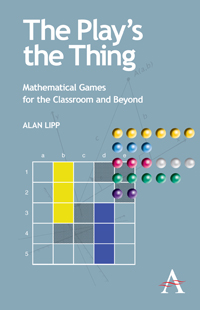 Though the games in The Play’s the Thing can be played by students at all levels, the book challenges students to develop a winning strategy: an effective way to win every time. With some of the games, known solutions exist, but with others, none have yet been found. In the Introduction, Mr. Lipp writes, “In some cases the answers are not known, but the question is presented in the belief that the search for an answer is worthwhile.”