I just found out that the knot theory research and paper I did last summer will be published. It’s my first paper! It is appearing the Journal of Knot Theory and Its Ramifications sometime this winter. If you’re curious, the paper is archived online here. (But no, we did not sneak in any (k)not theory puns.)
Please join me in congratulating Ms. Smith!
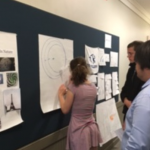
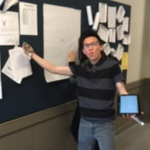
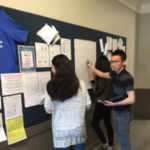
Also, while you’re at it, everyone should check out Ms. Smith’s awesome bulletin display now up in the math department hallway:
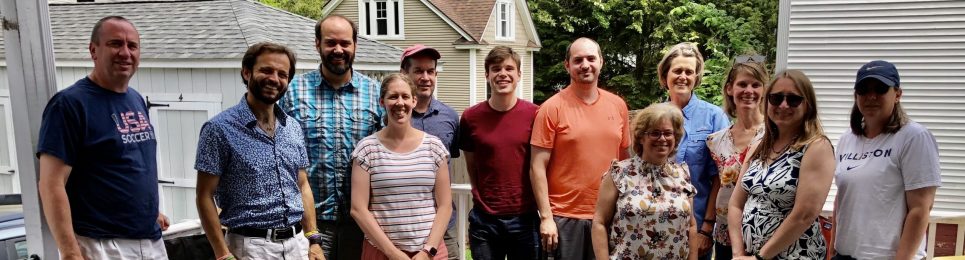
The math department is happy to be adding two new members to our family this year!
Please make sure to say hi to them as you see them around campus!
Katy Briedis
Katy Briedis joins the Williston faculty from Cushing Academy where she taught math and was a coach and a dorm parent. As a Cushing graduate she knows independent boarding schools. She will coach lacrosse and work in the athletic performance program. Katy has a B.A. in Mathematics from SUNY Potsdam and an MBA from Averett University. Katy lives at 30 Center St.
Mia Smith
Mia Smith graduated from Williams College this spring with a B.A. in Mathematics. She has been very involved in math communities both at Williams and beyond. She was a member of the Math Student Advisory Board at Williams, and her work also included MathCamps, a summer boarding program for exceptional math scholars around the world. At Williston Mia will teach math, coach cross country and lacrosse, and serve as a dorm parent. Mia lives in Logan House.
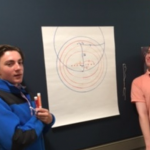
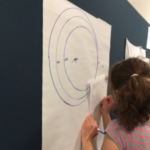
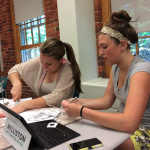
My Honors Precalculus class doing an exploration on how the eccentricity of an ellipse affects its shape. As they explored different ellipses with the same ‘a’ value, and determined that an ellipse with an eccentricity closer to 0 looks more like a circle, they had to analyze why that was the case by looking at the value of b as c approached zero.
You can try the activity yourself using this handout!
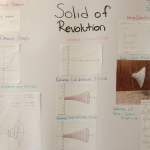
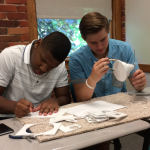
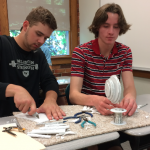
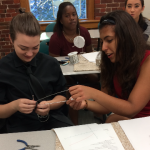
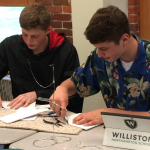
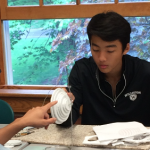
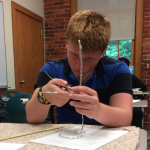
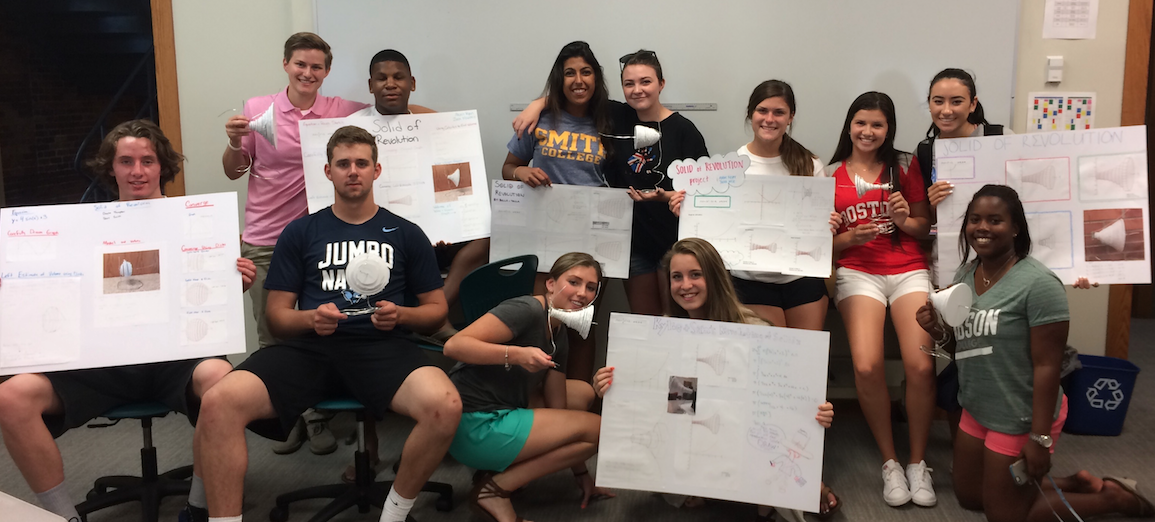
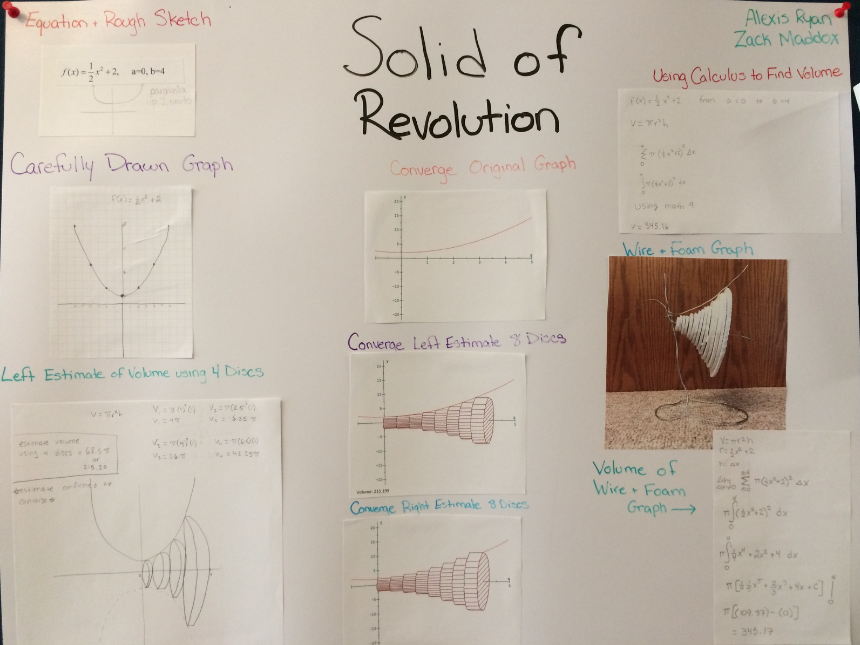
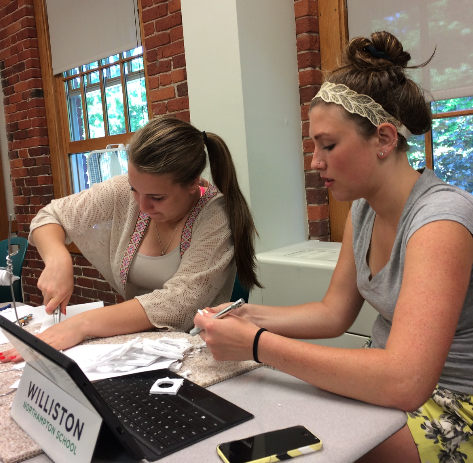
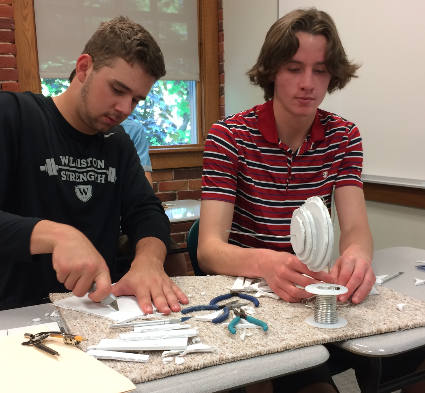
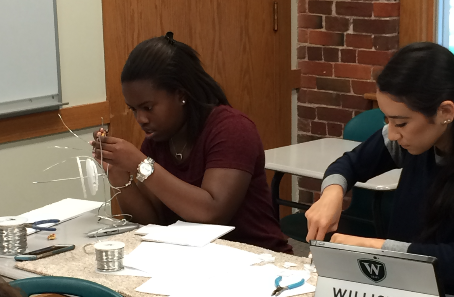
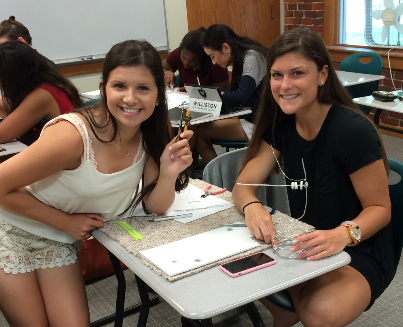
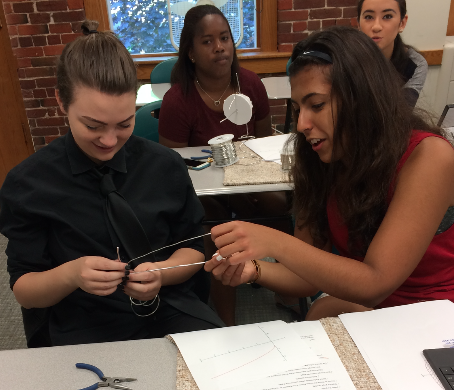
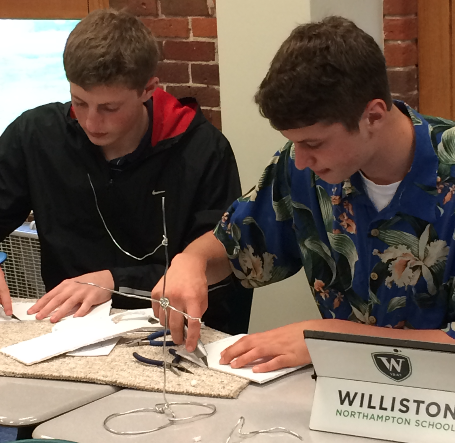
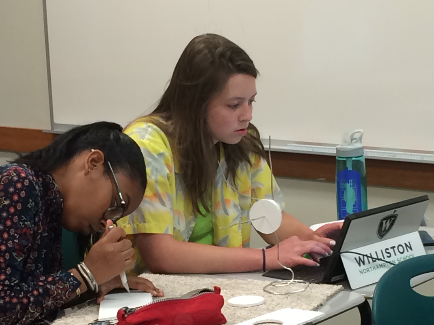
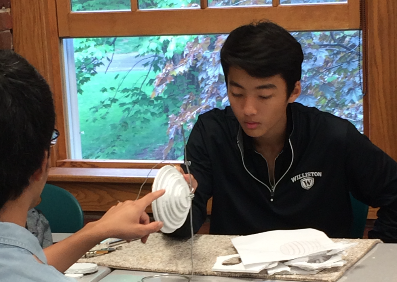
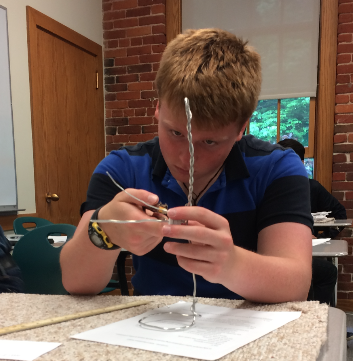
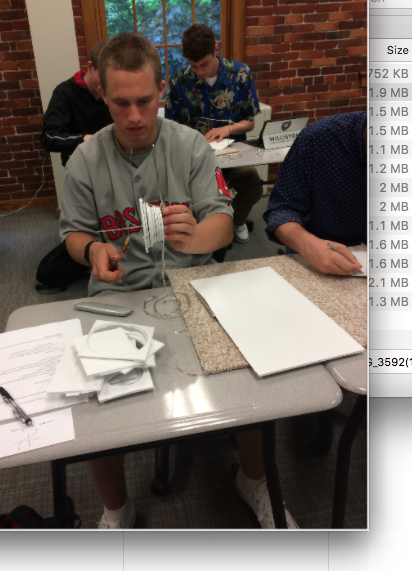
For the last few days in Calculus, with help from Mr. Roe in the Art Department, my classes built models as part of a project exploring solids of revolution. Partners were assigned an equation, asked to sketch and graph that equation and then find the volume of the solid that would be created by revolving that graph around the x-axis. They needed to sketch and estimate the volume if filled with only four cylinders, then find the estimated volume if filled with eight cylinders using a computer generated model. Using Calculus they were able to find the actual volume and compare it with their estimates. Next they needed to create a three dimensional model of their solid using wire and foam core. On the last day of classes they presented their project to their classmates. The projects were on display in the Reed Center in time for graduation for their families to see.
I am excited to announce a new award, the Upper School Mathematics Students of the Trimester!
Each math faculty member was free to choose whichever student of theirs they thought best exemplified what they are looking for in a model mathematics student. The official description of the award is as follows:
“Awarded to students who exemplify the math department’s core values of competence, confidence, and perseverance while helping their peers realize the relevance and importance of an exceptional mathematical education both for its beauty and for its practical application.”
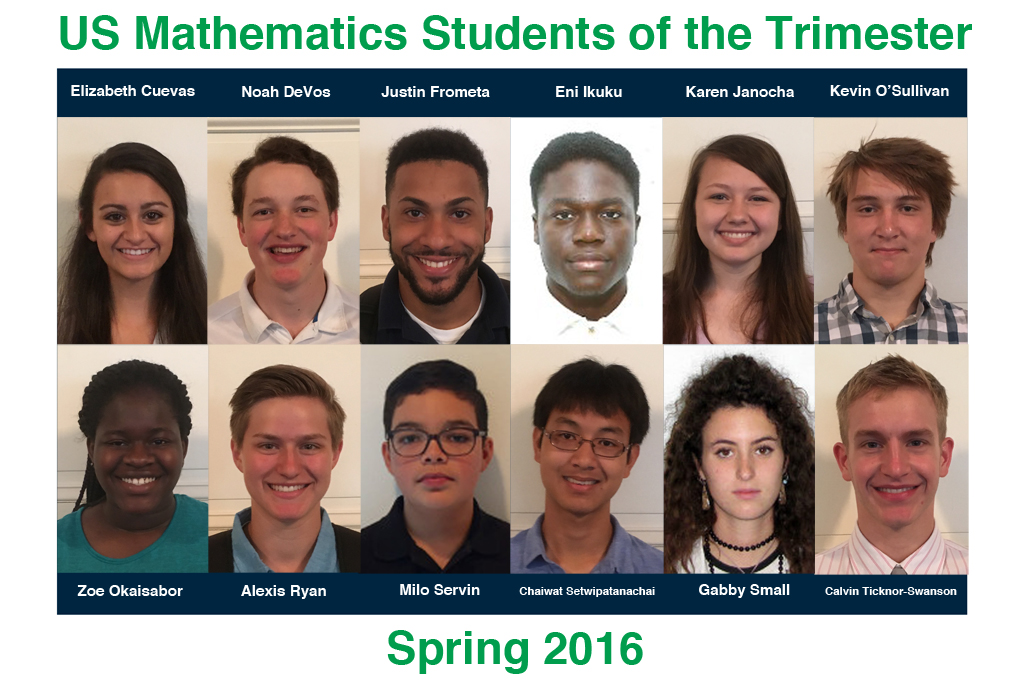
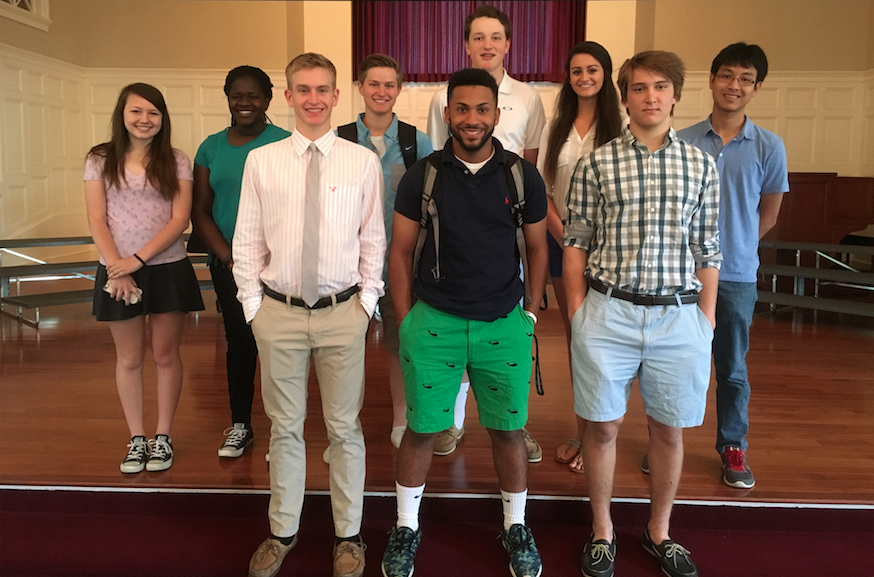
The following students have been recognized as the Upper School Mathematics Students of the Trimester for Spring 2016.
Please join me in congratulating these outstanding mathematics students!
Elizabeth Cuevas –Lizzie is an outstanding student who not only does well on all of her assignments, from daily homework to trimester assessments, but also encourages her classmates to succeed. She is constantly helping her peers both inside and outside of the classroom. She is gifted at explaining her work and ideas to others and often volunteers to do so in class.
Noah Devos – Noah is one of the leaders in our Precalculus class. He is always actively engaged with the material and asks questions that benefit the entire class. I can always rely on him to come to class ready to work. It has been a pleasure working with Noah this year.
Justin Frometa – Justin has been one of the most active participants in AP statistics this year. He arrives in class with detailed assignments and always has questions prepared. He models the curiosity and relentless pursuit of knowledge that we all hope to see in our math students.
Eni Ikuku – Eni has easily leveraged his previous experience in electronics to expand his knowledge of topics taught in this class. He dedicates himself to understanding the course material and asks intelligent and well though-out questions. He is well prepared for every assignment, every day.
Karen Janocha – Karen has been an able geometry student all year, but this spring her work has just been fantastic. She has been excelling on proofs involving similarity and right triangles, and she is always the first person to reach out to help other students. It’s been wonderful seeing her emerge as such a leader in the classroom.
Kevin O’Sullivan – Kevin has been a strong student in Precalculus all year long. He learns concepts quickly, and is able to apply his knowledge to new material. In class, he is always willing to lend his insights into the material to help the class keep moving forward.
Zoe Okaisabor – Zoe has worked hard all year in Algebra 1. She has gained a confidence in her work that has enabled her to make valuable contributions to the class. She has become an excellent math student through hard work and perseverance.
Alexis Ryan – Alexis’ work reflects this award. She “exemplifies the math department’s core values of competence, confidence, and perseverance while helping her classmates realize the relevance and importance of an exceptional mathematical education both for its beauty and for its practical application.” She gets gets excited when she works hard and masters a new concept. She works tirelessly to help her classmates. Her skills are very good and she believes in her ability.
Chaitwat Setwipatanachai – Team exemplifies the dedication, drive, and curiosity necessary to master a programming language. His reasoning is excellent, his attention to detail in his work is of the highest quality, and his contribution to our class discussion is steady, focused, and, at times, appropriately humorous.
Gabby Small – Every class needs a leader. Gaby Small has led her algebra class from day one this year. She is relentless in her pursuit of learning algebra, always willing to volunteer or to ask the key question that helps everyone understand a concept. With two complete notebooks, Gaby has never settled for anything less than her best. As a senior, her passion for learning has never waivered and she has demonstrated that learning math can be fun. I am so proud to award Gaby Small my student of the trimester award.
Milo Servin – Milo has shown himself to be a strong critical thinker and problem solver all year. This trimester all of the pieces to the puzzle have come together for him. As always, he is the group leader, sharing his quick understanding with his peers, but his depth of clarity has strengthened because he is taking more time to process and problem-solve. With more effort, focus and detail with his daily work, Milo has supported his ability beautifully which has translated into outstanding work on his assessments of all types. He has become a more complete mathematician by learning the value of paying attention to precision, the perfect complement to a student who is such a bright mathematical thinker!
Calvin Ticknor-Swanson – Even though class has become demonstrably harder over the past trimester, Calvin has not stepped off his domination of Calculus. He continues to demolish tests with carefully crafted work that shows, clearly, his complete command of the material. Additionally, he is humble about his abilities and is excited to work with others. I very much hope Calvin continues to take more math courses in college!
A few days after each AP Calculus BC exam, the College Board releases the free response questions from the exam. They don’t release their very succinct answer keys for a few more weeks… so… I had my students make their own answer keys as well as screen recordings of their solutions!
All released free response questions and answer keys are online right here.
The new course of studies booklet was just printed. Here’s the new introduction to the Math Department’s section:
Mathematics is the language of the universe. It is everywhere, and every subject is permeated by mathematics. It is beautiful, logical, abstract, relevant, and practical. Furthermore, a background in mathematics can lead you just about anywhere. Math majors have chosen careers from law, medicine, computer science, and engineering to philosophy and the visual and performing arts. Increasingly, many more professions require knowledge of higher mathematics for full success.
The world of mathematics is full of breathtaking examples of elegant beauty, brought forth from the luminary minds of people such as Noether, Erdos, Newton, Escher, Turing, and Lovelace. The Williston Mathematics Department strives to expose all students to that beauty while also realizing that many, if not all, students will need mathematics for its practical applications. The students of today are entering a quantitative world that demands an understanding of our subject. Through their studies of mathematics and with the support of a dedicated faculty, Williston students at all levels build habits of mind that translate into the many other areas of life that require problem solving.
A defining characteristic of humanity is our curiosity, and through our study of mathematics we continue the perpetual journey of understanding our existence. Mathematics is the bridge between the arts and the sciences, and we believe that everyone can find joy in mathematics.
The primary goal of Williston’s Math Department is to help prepare students for college mathematics. The course sequence—Algebra I, Geometry, Algebra II—teaches the foundation of mathematics that all students need. Once they have mastered the foundation, students can delve more deeply into mathematics through a variety of upper-level courses. While the content of these courses varies, the primary goal of each course is the same: to help students become more successful problem solvers.
In addition to different course options, students will encounter various tools and learning situations. Sometimes students will use computers to explore mathematics, or calculators to assist with graphing and computation. Students taking Geometry will participate in laboratories designed to provide time for extended work. At other times students will work in small groups to investigate a topic. All of these experiences encourage a flexible approach to mathematics.
Whether students dislike math or enjoy puzzle-thinking, have strong backgrounds or weak ones, they will find teachers dedicated to supporting their efforts to become better problem solvers. Each course offers the opportunity to review basic skills and to master the core knowledge of the subject. Students are challenged to move beyond memorized rules to discover the source of rules, to examine why they work, and to theorize about how they are used to solve problems.
As Roger Bacon proclaims, mathematics is a gateway. Like most gates it must be unlocked; and one cannot be pushed through it but must enter with one’s own effort.




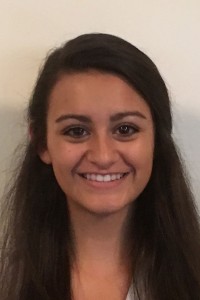 Elizabeth Cuevas – Lizzie is an outstanding student who not only does well on all of her assignments, from daily homework to trimester assessments, but also encourages her classmates to succeed. She is constantly helping her peers both inside and outside of the classroom. She is gifted at explaining her work and ideas to others and often volunteers to do so in class.
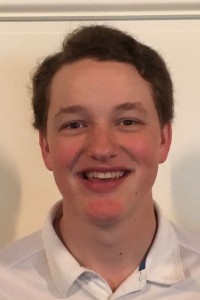 Noah Devos – Noah is one of the leaders in our Precalculus class. He is always actively engaged with the material and asks questions that benefit the entire class. I can always rely on him to come to class ready to work. It has been a pleasure working with Noah this year.
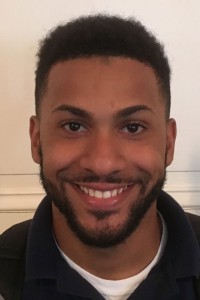 Justin Frometa – Justin has been one of the most active participants in AP statistics this year. He arrives in class with detailed assignments and always has questions prepared. He models the curiosity and relentless pursuit of knowledge that we all hope to see in our math students.
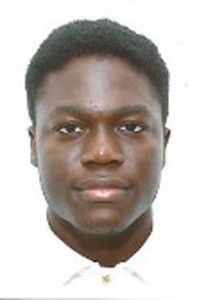 Eni Ikuku – Eni has easily leveraged his previous experience in electronics to expand his knowledge of topics taught in this class. He dedicates himself to understanding the course material and asks intelligent and well though-out questions. He is well prepared for every assignment, every day.
 Karen Janocha – Karen has been an able geometry student all year, but this spring her work has just been fantastic. She has been excelling on proofs involving similarity and right triangles, and she is always the first person to reach out to help other students. It’s been wonderful seeing her emerge as such a leader in the classroom.
 Kevin O’Sullivan – Kevin has been a strong student in Precalculus all year long. He learns concepts quickly, and is able to apply his knowledge to new material. In class, he is always willing to lend his insights into the material to help the class keep moving forward.
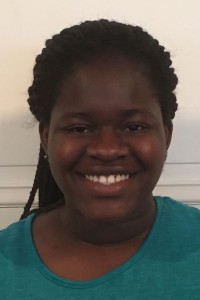 Zoe Okaisabor – Zoe has worked hard all year in Algebra 1. She has gained a confidence in her work that has enabled her to make valuable contributions to the class. She has become an excellent math student through hard work and perseverance.
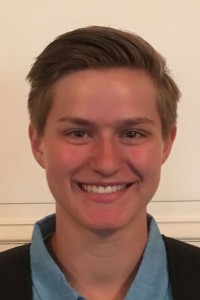 Alexis Ryan – Alexis’ work reflects this award. She “exemplifies the math department’s core values of competence, confidence, and perseverance while helping her classmates realize the relevance and importance of an exceptional mathematical education both for its beauty and for its practical application.” She gets gets excited when she works hard and masters a new concept. She works tirelessly to help her classmates. Her skills are very good and she believes in her ability.
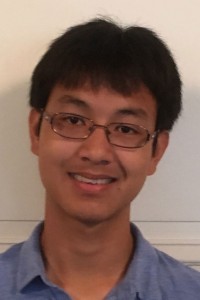 Chaitwat Setwipatanachai – Team exemplifies the dedication, drive, and curiosity necessary to master a programming language. His reasoning is excellent, his attention to detail in his work is of the highest quality, and his contribution to our class discussion is steady, focused, and, at times, appropriately humorous.
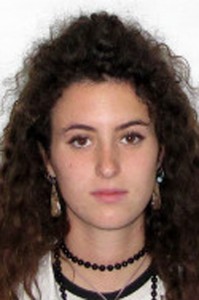 Gabby Small – Every class needs a leader. Gaby Small has led her algebra class from day one this year. She is relentless in her pursuit of learning algebra, always willing to volunteer or to ask the key question that helps everyone understand a concept. With two complete notebooks, Gaby has never settled for anything less than her best. As a senior, her passion for learning has never waivered and she has demonstrated that learning math can be fun. I am so proud to award Gaby Small my student of the trimester award.
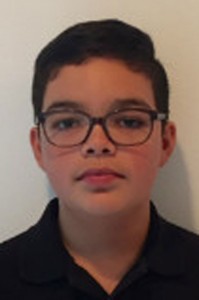 Milo Servin – Milo has shown himself to be a strong critical thinker and problem solver all year. This trimester all of the pieces to the puzzle have come together for him. As always, he is the group leader, sharing his quick understanding with his peers, but his depth of clarity has strengthened because he is taking more time to process and problem-solve. With more effort, focus and detail with his daily work, Milo has supported his ability beautifully which has translated into outstanding work on his assessments of all types. He has become a more complete mathematician by learning the value of paying attention to precision, the perfect complement to a student who is such a bright mathematical thinker!
 Calvin Ticknor-Swanson – Even though class has become demonstrably harder over the past trimester, Calvin has not stepped off his domination of Calculus. He continues to demolish tests with carefully crafted work that shows, clearly, his complete command of the material. Additionally, he is humble about his abilities and is excited to work with others. I very much hope Calvin continues to take more math courses in college!
 Note: Our 2017 answer keys are now online!